
Product family
Air Filtration Equipment & Components
Industrial air filtration components and equipment kept distinct from liquid-process filtration.
How to use this family page
Choose the operating concept before the model.
Air volume, required efficiency, particle characteristics, allowable pressure drop, installation space and the applicable test standard are reviewed together before a component or equipment configuration is proposed.
Engineering selection system
Select by air duty, dust risk and acceptable system resistance.
Efficiency class alone is incomplete. Air volume, particle characteristics, humidity, pressure drop, installation geometry and maintenance access must be reviewed as one ventilation system.
Define the air stream
Provide normal/peak air volume, temperature, humidity, duct size and whether the duty is supply, return or extraction.
Characterize the dust
Record particle size, concentration, abrasiveness, stickiness, moisture sensitivity and any combustible/toxic risk.
Set performance
Define required efficiency, allowable outlet concentration and clean/terminal pressure-drop budget.
Plan installation
Confirm footprint, duct interfaces, fan margin, media access, dust discharge and applicable local standard.
Preliminary route matrix
| Air-quality duty | Recommended starting route | Selection emphasis |
|---|---|---|
| Coarse particles and protection of downstream stages | Primary air filtration | Low resistance and dust-holding capacity. |
| Intermediate cleanliness or second-stage filtration | Medium-efficiency filtration | Efficiency/resistance balance and replacement interval. |
| Heavy dust loading requiring collection equipment | Dust filtration unit | Air volume, cleaning, hopper/discharge and fan duty. |
| Combustible, explosive or toxic dust | Special engineering review | Hazard controls and local compliance must precede sizing. |
RFQ readiness
Send the air-side design basis.
Photos help with layout, but the airflow and dust data determine the equipment.
- Normal / peak air volume
- Temperature, humidity and air composition
- Dust type, size and concentration
- Required efficiency or outlet limit
- Available pressure-drop / fan data
- Duct layout, space and discharge method
Efficiency and pressure-drop performance must be tied to an agreed test basis and operating condition. Hazardous dust applications require project-specific safety review.
Product configurations
Choose a technical starting point
Use the routes below to review a verified technical page or send the selected configuration directly to engineering. Final sizing follows the actual process conditions.
Selection route
Primary Air Filtration
Coarse pre-filtration components.
View technical page →Selection routeMedium-Efficiency Filtration
Intermediate air filtration components.
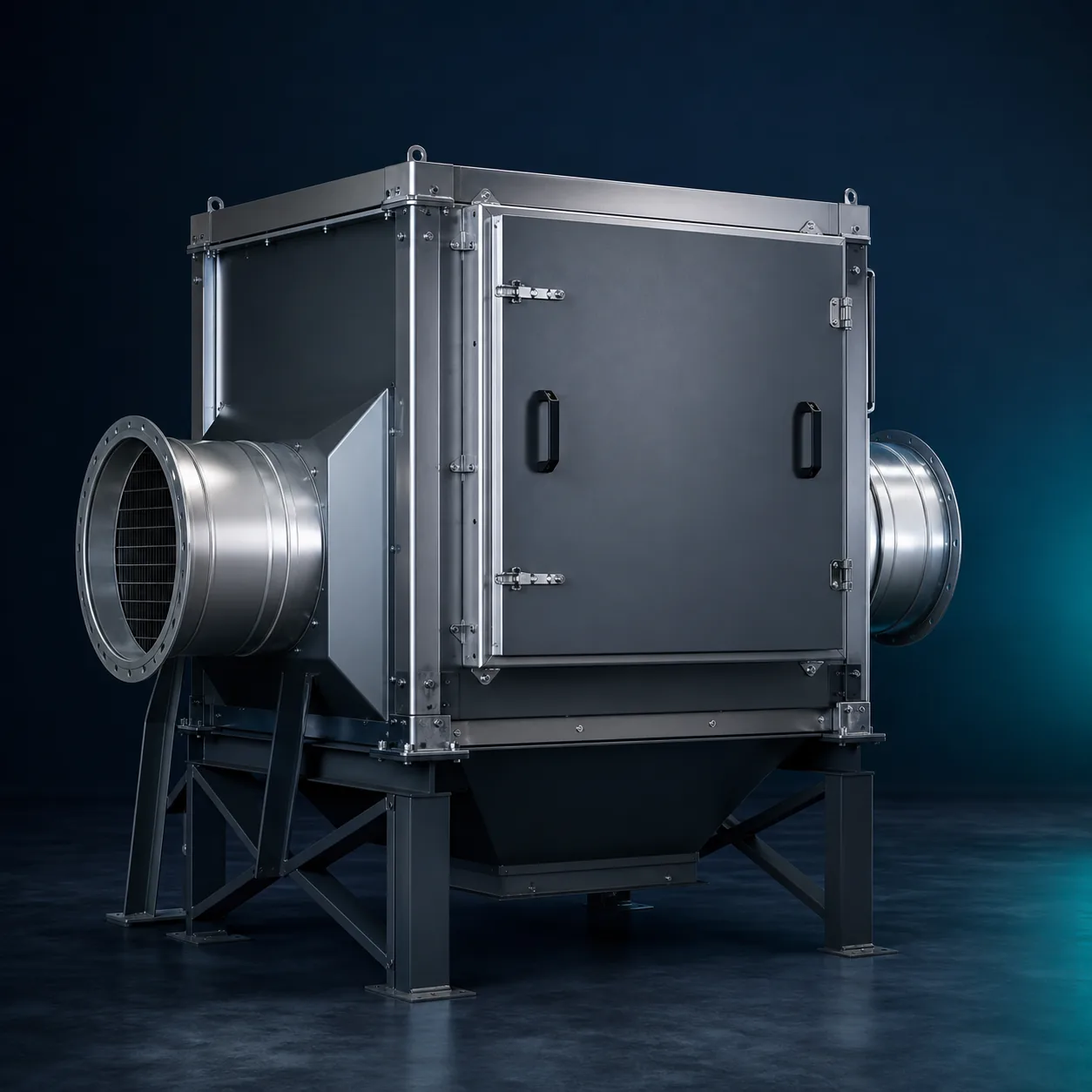
View technical page →Equipment routeDust Filtration Units
Equipment configurations reviewed per air volume and dust.
View technical page →Technical inquiry
Need help selecting within the air filtration equipment & components family?
Send the process conditions and we will route the request to the appropriate product configuration.